Introduction
A driveway that cracks within three winters. Pavers that shift and sink the moment the ground freezes. A deck that splinters, grays unevenly, or warps before it’s even paid for itself. This is what happens when the wrong materials are put in the ground, not eventually, but on a predictable timeline that most homeowners only find out about after the damage is already done. The materials chosen at the beginning of a project quietly define the look, function, and price of that yard five, ten, and twenty years down the road. There’s no fixing that decision afterward without tearing everything out and starting over. We built Randles Sand & Gravel around solving exactly this problem, supplying the rock, sand, and soil that form the foundation beneath landscapes engineered to last rather than landscapes that need to be re-done.
In this blog, we break down the specific materials that separate truly high-end landscapes from those that just look expensive for a season. We’ll talk about the hardness ratings behind premium decking, the chemistry behind weathering metal, and why some stone and lighting choices hold their value while others quietly fail. By the time you’re finished, you’ll know exactly what to look for, and what to avoid, the next time you’re planning a project.
The Psychology of “Expensive Looking” Landscapes
Expensive-looking yards almost never use more than two or three materials in all. The driveway is bordered in the same stone as the entry walk, creating a visual thread that feels intentional, while five different paver colors and three edging styles feel improvised. This is the quiet difference between luxury landscaping materials chosen with restraint and materials chosen piecemeal over several seasons; one creates a property that looks designed, the other looks assembled.
Natural Stone: The Non-Negotiable Foundation of Luxury Yards
Stone is still the backbone of every serious luxury yard project, but the reason has less to do with looks than most homeowners think. It really depends on what is underneath and how well it drains and compacts over time.
Why the Base Layer Decides Everything
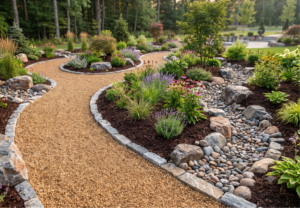
Natural stone landscaping only performs as well as the material packed beneath it. A driveway or patio built on properly graded, compacted crushed rock resists frost heave and won’t shift when the ground freezes and thaws through a Pacific Northwest winter. Skip that step or use a shallow, poorly compacted base and the stone above it will crack, settle unevenly, and need regrading in a handful of years, no matter how much the surface stone costs. We provide the crushed rock, quarry rock, and pit run material that forms this invisible foundation. It is the most overlooked factor in whether a stone feature will last a lifetime or need to be rebuilt.
Why Hardwoods Like Teak and Ipe Dominate High-End Outdoor Spaces
Teak and ipe decking isn’t chosen for aesthetics alone; it’s chosen because of a measurable property called the Janka hardness rating, which tests how much force it takes to dent a wood surface. Cedar sits around 350 pounds-force. Standard pine comes in near 690. Ipe measures roughly 3,680 pounds-force, making it one of the hardest commercially available woods on earth and explaining why ipe boardwalks have survived 25 years of foot and cart traffic without needing replacement. Teak, meanwhile, weathers to a silver-gray patina that many homeowners prefer to its original tone, aging on purpose rather than by accident. For luxury pool deck materials exposed to constant moisture and bare feet, that density difference is the entire reason one deck needs replacing in a decade, and another doesn’t.
The Role of Metal Accents, Corten Steel, Brass, and Bronze
Metal is one of the defining textures in contemporary luxury design, and Corten steel is leading that shift for a truly chemical, not stylistic, reason.
The Science Behind the Rust
Corten contains copper, chromium, and nickel, which cause it to form a dense oxide layer tightly bonded to the metal. The patina takes one to three years of alternating wet and dry exposure. And that layer, when it is mature, actually helps stop moisture and oxygen from reaching the steel beneath the surface. This is why Corten stops corroding rather than corroding away like normal steel. The catch: during those early years, loose rust runoff can stain concrete and stone, so Corten features are almost always installed over a gravel bed that absorbs the staining without showing it, another quiet reason drainage rock belongs under nearly every high-end metal accent. Brass and bronze fixtures follow a gentler version of the same principle, darkening and developing character rather than corroding.
A yard built on the wrong base doesn’t fail gradually; it fails on a schedule, and that schedule is shorter than most homeowners expect.
Why Luxury Homeowners Avoid Trendy Materials
Bargain composite pavers and dyed mulch photograph well for a season and then fade, crack, or wash out. Homeowners investing in premium outdoor living materials learn to spot the difference quickly:
| Material Choice | Year One | Year Five |
| Natural stone on compacted base | Sharp, dense, minimal settling | Weathered patina, structurally sound |
| Budget composite pavers | Bright, uniform color | Faded, cracked joints, visible wear |
| Ipe or teak decking | Rich tone or fresh grain | Stable, evenly aged, still structurally solid |
| Untreated softwood decking | Fresh-cut appearance | Splintering, warping, likely replacement |
Why Permeable Materials Are Becoming a Luxury Standard
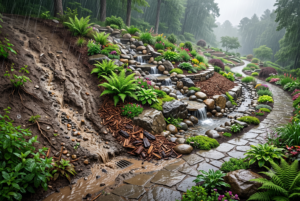
Eco-friendly luxury landscaping now leans heavily on permeable pavers and graded gravel systems that let water filter through instead of pooling against a foundation or eroding a slope. That’s no small upgrade in a wet winter climate; bad drainage is one of the quickest ways a driveway or patio falls apart from the ground up. Drain rock and carefully layered aggregate bases do this work quietly, protecting the visible surface above them from the water damage that ends most hardscape projects early.
How Lighting Materials Elevate a Landscape After Dark
Luxury landscape lighting is about more than where you place a fixture; color temperature changes the way every other material reads after sunset. A warm 2700K light flatters limestone, travertine, and wood tones, softening texture and mimicking golden-hour warmth; a slightly cooler 3000K brings out crisp definition in gray stone and metal accents. That’s exactly why brass and bronze fixtures are chosen, because they develop a patina outdoors as opposed to corroding or looking dated as painted aluminum will eventually do.
Building a Landscape That Doesn’t Need to Be Redone
The materials covered here- dense hardwoods, self-protecting metals, properly based natural stone, and drainage-conscious permeable systems- all share one trait: they’re engineered, chemically and structurally, to improve or hold steady with age instead of failing on a short timeline. That’s what separates every high-end property that still looks sharp a decade after installation while a neighbor’s yard is being torn out and repoured already.
At Randles Sand & Gravel, we supply the crushed rock, quarry rock, drain rock, sand, and topsoil that form the structural foundation beneath these kinds of landscapes, from properties in Graham and Lakewood to Port Orchard, Gig Harbor, Steilacoom, Tacoma, and Bonney Lake, WA. The visible stone, wood, and metal get the attention, but what’s packed and graded underneath is what determines whether a project lasts.
If you’re planning a driveway, patio, or outdoor living space you don’t want to rebuild in five years, talk to us before you break ground. Call us at (253) 531-6800 to discuss your project and get the right base materials from the start.