Most gravel failures don’t happen the day it’s delivered. They happen eight months later, when frost heave cracks a driveway that looked perfectly fine all summer, or when a “finished” backyard starts pooling water because nobody considered how fast the base layer could actually drain. Gravel follows physics, not looks, and the difference between a base that lasts 20 years and one that fails in two is often a matter of particle size, fines content, and compaction – stuff a supplier either knows or doesn’t. That’s the gap we built Randle’s Sand and Gravel to close, matching the right material to the right job instead of just moving rock off a pile.
This blog breaks down what actually separates one type of gravel from another, the technical factors that define quality material, and the questions worth asking before you order. By the end, you’ll be able to tell the difference between a supplier who’s guessing and one who knows exactly what your project needs.
Learn About the Different Types of Gravel and Their Uses
Gravel is categorized by the way it’s processed and how it performs under load or water, not how it looks in a pile. The most common reason a project fails is getting the category wrong.
1. Base and Structural Material
Crushed rock, such as ⅝ minus (CSTC) or 1¼ minus (CSBC), is manufactured with a multitude of particle sizes, from coarse stone down to fine dust, so it packs together. This graded mix is what makes it good for driveways and road bases; a single uniform size, no matter how hard the stone, will never compact the same way.
2. Drainage Material
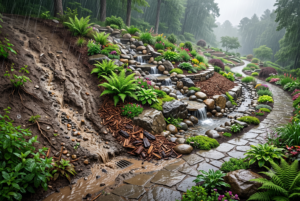
Drain rock is washed to strip out fines almost entirely, which keeps the voids between stones open so water passes through instead of pooling. Because it isn’t graded for compaction, it should never sit beneath a load-bearing surface; that mismatch alone causes a large share of driveway settling.
3. Decorative and Surface Material
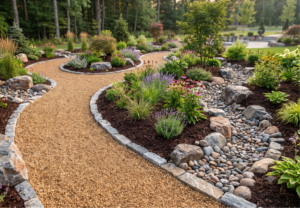
Pea gravel and other rounded stone are more about comfort and looks than interlocking. Because it is rounded, it moves underfoot, which is fine for a path but a liability anywhere vehicles or heavy foot traffic exert repeated pressure.
A supplier who can name which category your project needs before you ask is telling you something about how they run their yard.
Key Factors That Define High-Quality Gravel
The quality of gravel is not a visual matter, but it can be measured. A pile of dusty, unwashed rock and a pile of properly graded material can look almost identical, but once they are under a structure, they can perform totally differently.
| Factor | What It Actually Affects |
| Fines content | Crushed rock kept below roughly 10–12% fines drains and compacts more reliably; higher fines trap moisture and weaken the base |
| Hardness | Harder stone resists breaking down into fine dust under repeated vehicle loading over time |
| Angularity | Crushed, angular faces interlock mechanically; rounded stone shifts instead of locking |
| Gradation consistency | Matching particle sizes load to load prevents weak, uneven spots forming across a base |
Any one of these, and the result is not cosmetic. The base material is under-compacted and has a lot of fines in it, both of which retain water that expands about 9% when frozen. This expansion causes frost heave and is what turns a smooth driveway into a cracked one by the following spring.
How to Evaluate a Gravel Supplier Before Ordering
A few direct questions before ordering save far more trouble than any amount of research after a bad delivery.
- How is the material processed? Washed and screened rock performs consistently; unprocessed pit material varies load to load.
- Do they operate their own trucks? In-house delivery means fewer scheduling gaps and more control over when material actually arrives.
- Can they explain gradation, not just price? A supplier who can walk you through why one product suits your project and another doesn’t is worth far more than one quoting a number.
- Will they help calculate quantity? Under-ordering stalls a project mid-pour; over-ordering leaves you paying to have excess hauled away.
We’ve run our own fleet and trained team out of three Puget Sound locations since 1987, which is exactly the kind of consistency this list is built to test for.
Why Gravel Size, Texture, and Composition Matter
Particle size determines drainage speed and load-bearing capacity in opposite directions: larger stone drains faster but compacts poorly, while finer graded material compacts densely but needs a separate drainage layer beneath it to avoid trapping water against the base. Texture complicates this: angular, crushed faces are resistant to lateral movement under weight; rounded stone, even of the same size, will shift and rut under the same weight.
Composition adds a third variable. Washed sand, crushed quarry rock, and pit run all interact with moisture differently, which is why a base engineered for a driveway and a bed engineered for pipe work are never built from the same material, even when both are labeled “gravel.” Getting this wrong doesn’t just shorten a project’s lifespan; it usually means removing and replacing the base entirely, since these failures happen below the surface where they can’t be patched.
How to Choose the Right Gravel Supplier for Your Project
Price per yard is the easiest number to compare and the least useful one on its own. What actually determines whether a project succeeds is whether the supplier stocks the right range of material and can get it to you before your timeline is compromised.
- Product breadth: A yard carrying washed gravel, sand, crushed rock, quarry rock, and soil products in one place removes the need to coordinate multiple vendors on a single job.
- Delivery reliability: A supplier who can commit to a firm delivery window, not just a “sometime this week” estimate, keeps a crew from losing paid hours standing around.
- Recycled and fill capacity: Yards that accept and reprocess concrete, asphalt, and clean fill tend to run fuller-service operations overall.
- Willingness to advise, not just sell: A supplier who corrects your order when you’ve picked the wrong product is protecting your project, not costing themselves a sale.
We built three yards from the Puget Sound to Mt. Rainier, so a homeowner or contractor gets the same product knowledge and delivery reliability whether they’re closer to Puyallup or out toward Bonney Lake or Graham. The goal is that where you are located shouldn’t determine the quality of what you get.
What Your Base Layer Determines Long After the Project Looks Finished
Every day that the material beneath a driveway, patio, or drainage system is in the ground, it is doing structural work, and its performance is based on gradation, fines content, and compaction, not on how uniform the pile looked when it was delivered. Getting it right the first time is what separates a base that will last decades from one that will have to be torn out and redone.
We’ve supplied topsoil, gravel, sand, and landscape rock across the South Puget Sound since 1987, and that includes serving as a trusted gravel supplier in Eatonville, Gig Harbor, Lakewood, Puyallup, Steilacoom, Tacoma, and Port Orchard that residents and contractors call on, with our own fleet and trained staff behind every delivery; the same standards apply whether you’re working with us on a gravel supplier Bonney Lake, WA project or a Graham job.
If you’re not sure which product your project calls for, talk to us before you order rather than after something’s already in the ground. (253) 531-6800