Most landscaping failures don’t announce themselves on day one. A driveway base that doesn’t have the right mix of particle sizes looks good at first, but then ruts or cracks after a season of rain and freeze-thaw. A garden bed with the wrong soil mix will grow plants well for a few weeks before problems with drainage and nutrient deficiencies show up as yellowing leaves and root rot. It’s not a bad luck casualty; it’s a material decision made months ago that no one questioned at the time.
That’s the gap we at Randles Sand and Gravel exist to close by making sure the product going into your project is actually built for the job it’s asked to do.
This guide explains the difference between a landscape that lasts decades and one that has to be redone in two years: how materials are graded, what to look for before you take a load, what really drives pricing, and how to match products to specific projects. By the end, you will know how to ask for materials based on their actual technical properties, not just their name.
Understanding Different Types of Landscape Materials
Landscape materials aren’t interchangeable just because two products look similar in a pile. How a material is processed and graded determines how it will react once it’s compacted or planted into. And that reaction determines if your project stands up.
1. Graded Rock vs. Clean Rock
A “well-graded” product, like ⅝-minus crushed surfacing top course (CSTC), is an intentional mix of particle sizes, from coarse rock to fine dust. When compacted, the smaller particles fill the spaces between the larger ones and lock everything into a dense mass with little room left inside. A “clean” product, like ¾” clean stone, is screened to remove those fines, leaving 30 to 40 percent void space between rocks. That void space is exactly what a French drain needs so water can move through freely, but it’s exactly what a driveway can’t use, since open-graded stone never locks together the way a structural base requires.
2. Washed Sand vs. Unwashed Fill
Washed sand has had silt and clay stripped out during processing. Mason sand is fine and rounded, used to level pavers with no abrasive edges. Concrete sand is a coarser and angular sand that will hold concrete mixes together. Unwashed fill dirt still has natural clay content, which is good for bulk grading but not for where drainage or compaction accuracy is important, as clay holds water and swells unpredictably.
A driveway base and a French drain can be built from rock that looks nearly identical in the pile; swapping one for the other is one of the fastest ways to turn a new driveway into a pothole field.
Whether you’re sourcing landscape materials in Puyallup for a new build or lining up landscape materials in Tacoma for a drainage project, understanding this distinction before ordering prevents the wrong product from ending up under the wrong structure.
How to Evaluate the Quality of Landscape Materials
Quality in aggregate and soil products is checkable, not visual guesswork.
- Gradation consistency: A well-graded base should feel like a continuous range of particle sizes, not oversized chunks sitting in a bed of dust.
- Fines in washed material: True washed sand or gravel should leave your hands dry. A muddy film means silt wasn’t fully removed, and it will clog drainage later.
- Soil crumb structure: Garden or lawn mix should crumble apart in your hand. A dense clump signals excess clay, which restricts root-zone oxygen and encourages rot in wet months.
- Organic matter balance: Not enough organic content won’t hold moisture; too much unfinished organic matter can rob nitrogen from young plants as it continues to decompose.
- Rock source density: Basalt-based crushed rock resists breakdown far better over time than softer sedimentary sources, which matters most under anything bearing repeated weight.
Anyone bringing in landscape materials in Graham for a project combining hardscape and planting beds should expect to check both categories, since most residential jobs use structural base material and a soil component in the same build.
What Factors Affect Landscape Material Costs?
Pricing is driven by specific variables rather than a flat per-yard rate.
- How much processing it went through: Pit-run material comes straight out of the ground, while washed, precision-graded products go through extra screening steps that add real cost.
- The size of your order: A delivery truck costs about the same to send whether it’s carrying five yards or fifteen, so larger orders bring the per-yard rate down.
- How far it has to travel: Fuel and driver time add up over distance, so a load headed further from the yard costs more to deliver.
- How available the material is: Large basalt boulders take more selective quarrying than standard crushed rock, so supply isn’t always as ready.
- What time of year it is: Demand climbs in spring and summer, which can tighten availability even when pricing stays steady.
Homeowners planning landscape materials in Lakewood often overorder or underorder by estimating volume by eye. To avoid a second delivery fee and wasted material, use a gravel calculator or give our team a call directly.
Choosing Durable Materials for Long-Lasting Landscapes
Durability comes down to how a material behaves under repeated seasonal stress. The stress in the Puget Sound region is freeze-thaw cycling and long wet periods, both of which punish a poorly selected base much more rapidly than a dry climate would.
Then moisture trapped in a fines-heavy base freezes, expands, and lifts the surface above it. And repeat that over a few winters, and you get cracking and heaving in driveways and patios that are built on the wrong foundation. A well-graded, properly compacted base drains that moisture before it freezes, which is why CSTC and CSBC remain standard under anything load-bearing here.
| Material | Compaction Behavior | Freeze-Thaw Resistance |
| CSTC / CSBC (graded basalt) | Locks tight, minimal voids | High: drains before freezing |
| Clean crushed rock | Won’t compact, high void space | Not applicable (used for drainage) |
| Pit run (unscreened) | Inconsistent, unpredictable | Low: retains moisture, heaves |
| Quarry spalls / landscape rock | Stable by mass, not compaction | High: resists movement |
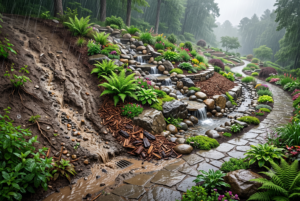
On slopes, smaller decorative gravel migrates downhill under heavy rain, while larger quarry spalls and landscape rock stay put through sheer mass, which is why erosion control near landscape materials in Port Orchard or any sloped terrain calls for rock, not gravel.
How to Select the Right Materials for Your Landscaping Project
What’s right is the material that meets the physical demands of the project, not preference or what is on hand.
1. Structural Projects
Driveways and patio bases need a layered approach: CSBC as the deeper structural layer, topped with CSTC compacted in lifts. One common cause of early failure of structural bases is not using layering, or using only one uniform depth.
2. Drainage-Dependent Projects
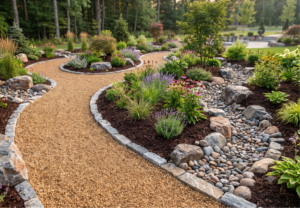
Open-graded drain rock is used in French drains and footing drains because it will not compact. It is wrapped in geotextile fabric before backfilling to prevent the surrounding soil fines from migrating into the void space and choking the drain years later, a failure that often goes unnoticed until standing water reappears.
3. Planting and Growing Projects
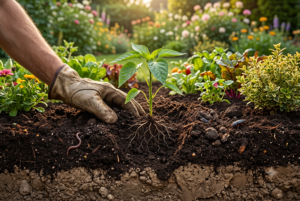
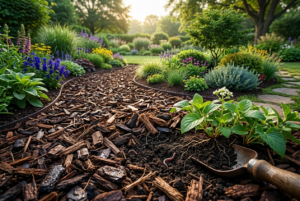
Garden beds depend on soil structure above all else. Garden mix blended with finished compost, not raw bark, supports root development without the nitrogen drawdown that unfinished woody material causes while decomposing near plant roots.
Whether you’re weighing landscape materials in Steilacoom or comparing needs for landscape materials in Bonney Lake, WA, matching the category above to your project is the fastest way to avoid a product that technically works but wasn’t built for the job.
Building a Landscape That Actually Holds Up
Getting these decisions right the first time separates a landscape that needs no attention for a decade from one that needs partial rebuilding within a year or two. Gradation, drainage, soil structure, and source material all work together. Omitting the research on any one of them usually shows up later as a heaved driveway, clogged drain, or plants that never take hold.
Since 1987, we at Randles Sand and Gravel have supplied contractors and homeowners with topsoil, gravel, sand, bark, and crushed and quarry rock from our three yards, including Lynch Creek Quarry near Eatonville, the source of much of our basalt rock, along with our Puyallup and Gig Harbor locations. Our staff can walk through gradation, drainage, and soil questions directly, and our drivers handle delivery so material arrives ready to use. Anyone sourcing landscape materials in Eatonville or from any of our other locations gets that same product knowledge on every order.
If you’d rather talk through your project than guess at what it needs, call our team at (253) 531-6800 and we’ll help you land on the right material before the first load ever leaves the yard.