A yard doesn’t fail all at once. It fails one storm at a time, a few grams of topsoil lifted off a slope, carried into a low spot, and left there while the high ground quietly thins out. Most homeowners never get to see this happen, as it just looks like a little muddy runoff when it rains. That way, the soil that runs off is gone forever from the property, and once the topsoil layer has been stripped off a slope, nothing you ever plant there will ever take root deep enough to hold the ground on its own again. That’s the point where a yard stops being a maintenance issue and becomes a structural one: undermined foundations, slumping retaining walls, and drainage systems clogged with sediment they were never built to handle. At Randles Sand & Gravel, we’ve supplied the materials that stop this cycle before it starts, and understanding how they actually work is the first step to protecting your property.
This blog breaks down the engineering behind erosion control, not just the marketing version of it. We’ll cover why rock shape and sizing matter more than most people realize, what depth of bark mulch actually holds soil in place versus what just looks good, and how combining the two creates a stormwater management system that works with our regional rainfall instead of against it.
How Landscape Rock Prevents Soil Erosion
Not all rocks protect a slope the same way, and that is where most DIY erosion fixes fail. Landscape rock functions by absorbing and redirecting the energy of moving water before it can strip soil away, but how well it does that depends almost entirely on shape and sizing.
1. Why Angular Rock Outperforms Round Rock
Attractive rounded river rock, but it rolls under continuous water flow. Angular, crushed stone locks against adjacent pieces and distributes the force of runoff across the entire layer, rather than concentrating it on individual stones. A smooth, rounded stone will roll and displace under sustained water velocity; angular stone locks in place and distributes force across the mass of the layer. That interlocking behavior is exactly why we prefer angular crushed and quarry rock for slope and channel applications instead of decorative round stone.
2. Matching Rock Size to Slope Grade
How much rock is enough depends on the slope grade. Generally, as a rule of thumb in engineering design, riprap slope protection is specified at a 2:1 slope ratio or flatter, with steeper grades requiring more design consideration, and slopes steeper than 2:1 typically requiring materials other than standard riprap altogether. For lighter applications like drainage rock along downspouts or foundation perimeters, the U.S. Department of Agriculture’s erosion control standards call for a minimum particle size of roughly ¾ inch and a minimum depth of two inches to keep the layer from shifting under normal rainfall. scribd
A slope that looks stable in July can fail completely by the first hard rain in November; sizing has to account for the worst storm of the year, not the driest month.
Benefits of Bark Mulch for Healthy Landscapes
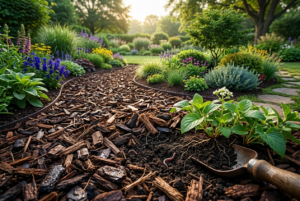
Bark mulch protects soil differently than rock does. Instead of resisting water through weight, it absorbs the direct impact of raindrops before they strike bare earth, which prevents the fine soil particles from ever loosening in the first place.
Depth is where most homeowners get it wrong. Industry erosion-control guidance consistently points to a two-to-four-inch layer as the effective range, with less than two inches failing to hold displacement and more than four inches actually working against the soil, trapping moisture, starving roots of oxygen, and undoing the benefit it was meant to provide. In one study of urban soils, mulch applied at the proper rate decreased runoff generation by 58% to 83% compared with bare ground, a significant difference between a yard that sheds water and one that absorbs it. In addition to its resistance to erosion, a well-maintained layer of bark will starve weeds, insulate roots through temperature swings, and slowly return organic matter to the soil as it breaks down, something rock alone never does.
Combining Rock and Mulch for Better Drainage
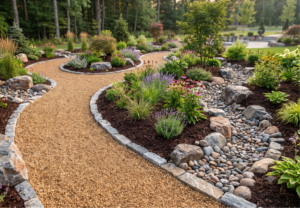
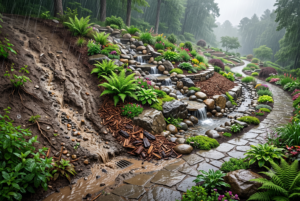
Neither material solves the whole problem alone. Rock handles concentrated, high-velocity flow; mulch handles surface protection and moisture retention across broader beds. Used together, they form a layered defense that improves yard drainage solutions across an entire property rather than patching one trouble spot at a time.
| Zone | Best Material | Depth Guideline |
| Downspouts, foundation edges | Angular drainage rock | 2 inches minimum |
| Slopes exceeding 2:1 grade | Larger crushed or quarry rock | Sized to slope, not guessed |
| Planting beds, softer zones | Bark mulch or compost | 2–4 inches |
| Transition/mixed zones | Rock border, mulched interior | Layered per section |
This layered approach is the backbone of practical stormwater management on residential and commercial sites alike, and it’s the difference between a yard that reacts to every storm and one that’s built to handle it.
Climate-Smart Solutions for Erosion Control
Here in western Washington, rain doesn’t fall in quick bursts as it does in drier climes. It moves in for months, keeping soil saturated far longer than most erosion-control products are rated to handle anywhere else in the country. Properties around Tacoma, Lakewood, Graham, Bonney Lake, WA, Gig Harbor, Port Orchard, and Steilacoom all share this same seasonal challenge, and it’s why undersized rock or thin mulch that might hold up in a milder climate often fails here within a single wet season. Here, more than almost anywhere else in the state, materials are sized for sustained saturation and repeated freeze-thaw cycles.
Choosing the Right Materials for Lasting Protection
One of the most common, and most expensive, mistakes we see is selecting materials without considering slope grade, water volume, and soil type. Before you choose:
- Steeper slopes need larger, angular rock, sized to the grade rather than to appearance.
- High-runoff areas call for drainage rock, not decorative gravel.
- Clay-heavy soil benefits from added mulch depth to slow surface pooling.
- Full-sun beds dry faster and need consistent mulch depth to retain moisture,
We carry a full selection of angular crushed rock, quarry rock, and graded landscape bark so that each zone on a property can be matched to what it really needs, not a one-size-fits-all layer.
Protecting the Ground Beneath Your Landscape
Erosion does not ask for permission; it does its work silently with every rainfall until finally a slope, bed, or drainage path fails. By the time the fix is in place, it is far more expensive than prevention would have been. The materials that stop it are not complicated, but only work when sized and layered properly. Angular rock for concentrated flow. Properly depthed mulch for surface protection. The two combined wherever a property faces both.
Randles Sand & Gravel has supplied landscape material to homeowners and contractors across the Puget Sound region since 1987, with three locations positioned to keep delivery fast and selection wide. Our team can help match rock size and mulch depth to your specific slope and soil conditions rather than guessing at what “should” work.
If erosion is already visible on your property, waiting through another storm season will only make the repair larger. (253) 531-6800 connects you directly with our team to talk through the right materials for your yard.