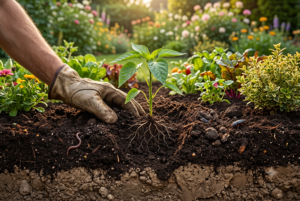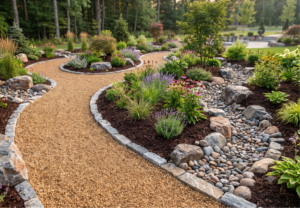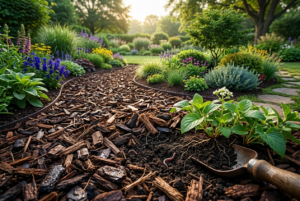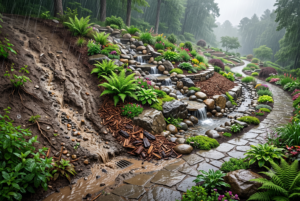
A yard doesn’t fail overnight. It fails in small, avoidable increments: a base layer that was never compacted to spec, a mulch bed that holds moisture two weeks longer than it should, a stone chosen for its color rather than its drainage rate. Each of those choices may seem harmless until a freeze-thaw cycle finds the weak point or the humidity finds the mold-friendly material, and what appeared to be a finished project suddenly needs to be dug up and redone.
Most homeowners don’t realize they’re creating a climate mismatch until the material is already failing, and by then the repair costs more time, more labor, and more frustration than doing it right the first time. That’s the gap Randles Sand and Gravel exists to close: decades of watching which materials actually hold up under real Pacific Northwest conditions, not just which ones look good on delivery day.
This guide walks through the specific material choices that hold up against coastal humidity, freeze-thaw cycles, heat stress, and small-lot drainage limits. We’ll cover what changes near saltwater, which aggregates resist compaction failure, and how to choose based on how much yard maintenance you actually want. By the end, you’ll know exactly what to request and why it matters for your specific property.
Coastal Yards Need Different Rules
Salt-laden air behaves differently than people expect; it doesn’t just sit on the surface, it works into porous materials and accelerates breakdown from the inside. Coastal landscaping materials must be able to resist moisture absorption as well as salt-driven corrosion, which means that many of the standard options homeowners take for granted won’t work.
Why Porosity Matters More Than Looks
The porosity rate of a stone or aggregate is the amount of saline moisture it takes in before that moisture freezes and expands, cracking the material from within. Why does clean, angular aggregate with low porosity, such as washed crushed rock, shed moisture instead of holding it? That’s why it always outperforms softer, more absorbent stone in yards near Gig Harbor or Steilacoom. Untreated softwood mulch is the opposite case: it holds salt spray against plant roots and speeds up decay, so if you’re within a few hundred yards of open water, an aggregate base will simply last longer than an organic one.
Materials That Beat the Heat
Dark, organic materials absorb and hold heat at the surface, which stresses root systems and dries out topsoil faster than most people account for. Heat-resistant landscape materials work by reflecting rather than absorbing; lighter aggregate surfaces run measurably cooler than dark mulch on the same afternoon, which matters more than color preference once temperatures climb. Pea gravel is a useful middle ground here. It reflects enough heat to protect the base layer, but also holds a thin film of moisture at the surface, preventing any nearby plantings from completely drying out during a dry stretch.
A yard that can’t handle its hottest week and its coldest week is a yard you’ll be repairing twice a year.
Hot, Humid, or Freezing? Match Materials Accordingly
The Puget Sound region doesn’t hold on to one climate condition for long, and that’s exactly why so many yards fail: they’re built for the mild average, not the extremes that actually happen. Landscaping materials by climate zone account for the fact that a base layer engineered for summer drainage isn’t automatically engineered to resist winter heaving.
| Seasonal Stress | What Fails If Ignored | Material That Resists It |
| Freeze-thaw cycling (Graham, Bonney Lake WA) | Base heaves, pavers shift and crack | Compacted crushed rock (CSTC/CSBC) |
| Coastal humidity (Gig Harbor) | Mold, salt-driven material breakdown | Washed drain rock, clean aggregate |
| Sustained summer heat | Root stress, surface cracking | Pea gravel, quarry rock |
| Mixed seasonal swing | Erosion, drainage failure | Layered rock-and-topsoil base |
Ignore this layering and the base will eventually shift under its own material, not from poor installation, but from a mismatch between what was used and what the season actually demanded.
Low-Maintenance vs. Hands-On Lifestyles
How much time you actually want to spend outside changes which durable outdoor landscape materials make sense, and this is a decision worth making honestly before a single yard of material gets delivered.
If You Want the Yard to Take Care of Itself
Crushed rock beds, landscape rock borders, and cedar play chips in play areas all hold their form without seasonal upkeep. Skip garden mix here; it invites the kind of planting maintenance that defeats the purpose.
If You Actually Enjoy the Work
Lawn mix and garden mix reward regular attention with plantings that can be rotated seasonally. Decorative stone landscaping accents provide you a structural base to build around as your beds evolve year to year.
Small Yard, Smart Material Choices
Tight lots punish oversized material choices fast; a coarse base or an ambitious mulch bed eats visible square footage a small yard can’t spare. Finer-format decorative stone landscaping, like pea gravel or ¼-inch minus, visually opens a compact space while still draining correctly on a lot that likely has poor natural grading to begin with. Quarry spalls work well as low borders that define planting areas without consuming the depth a taller feature would.
Local Materials Save Money Long-Term
Local landscaping materials are already suited to the soil chemistry and moisture behavior of the region they’re sold in; imported aggregate isn’t, and that mismatch shows up over time in drainage and settling issues imported soil rarely accounts for. As a major producer of sand, gravel, and topsoil in the Puget Sound area, we keep consistent batches of crushed rock, washed sand, and local landscaping materials on hand, which matters when a Tacoma project started this spring needs matching material again by fall.
Allergy and Pollen-Conscious Choices
Most people don’t know how much of a role ground cover plays in indoor allergy exposure; bark and compost trap pollen and mold spores on the surface, and humid stretches only make that worse, not better. Inert landscape gravel supply options don’t hold onto airborne allergens the same way organic mulch does, which is why swapping bark near windows and entryways for gravel or landscape rock measurably reduces what gets tracked indoors. Reserve compost for garden beds set away from the house, where its benefits outweigh the tradeoff.
Building a Yard That Actually Lasts
Selecting outdoor landscape materials is not a cosmetic decision, it is an engineering decision, and anything else is exactly how yards come to require early, expensive rework. The right mix depends on how close you live to water, the amount of temperature variation over the seasons, the size of your lot, and how much hands-on maintenance you’re really willing to undertake. Skip that matching process, and the failure isn’t a matter of if but when.
Randles Sand and Gravel has supplied topsoil, gravel, bark, and landscape rock to homeowners and contractors since 1987, with three locations stretching from the Puget Sound to Mt. Rainier, a footprint that means our team has seen firsthand how differently a yard performs in Lakewood compared to Port Orchard, or Tacoma compared to Steilacoom. That regional experience shapes every recommendation we give, rather than a one-size-fits-all suggestion pulled from a catalog.
If your yard is anywhere across the South Puget Sound region and you want material advice specific to your property’s actual conditions, give our team a call at (253) 531-6800, and we’ll help you choose right the first time.