Introduction
Every landscape is already fighting a losing battle against water; most homeowners just haven’t been told this yet. Rain hitting a compacted lawn or sealed driveway runs off rather than soaks in. It washes off topsoil from beds, pools up against foundations, and erodes the base under patios until they crack. Left unaddressed, this cycle compounds year after year, turning a manageable drainage issue into an expensive regrading project. We built our business around solving exactly this problem, and for almost four decades, we’ve helped property owners across the South Puget Sound choose materials that stop this cycle before it starts.
This guide presents eight material-based strategies for a landscape that manages water rather than losing it to the water, drawing on research most homeowners never see, ranging from what happens under compacted soil to why tire dust is one of the most studied pollutants in our regional waterways.
What “Climate-Smart” Actually Means
According to the EPA, impervious surfaces in an area increase stormwater runoff. Once 10 to 20 percent of an area has impervious surfaces, the runoff roughly doubles from a naturally vegetated landscape, and with full impervious coverage, runoff can be five times the runoff of a forested area. Most residential yards sit closer to that tipping point than owners assume, between roofs, driveways, and compacted lawns.
A climate-smart landscape uses eco-friendly landscape materials chosen for how they move water, not just how they look. That’s the premise behind sustainable landscaping: every material either helps rainfall return to the ground or forces it elsewhere, and that choice determines whether a property weathers a Pacific Northwest winter or spends every spring recovering from it.
Start With the Soil, Not the Surface
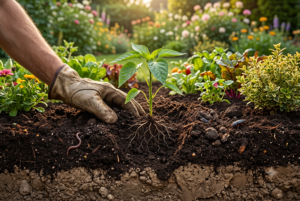
Before any landscape materials go down, the soil underneath needs to actually function, and in most residential properties, it doesn’t.
Why Compacted Soil Undermines Everything Above It
When construction or foot traffic occurs, it compresses the particles of the soil together, collapsing pore space. Studies have documented reductions in infiltration rates of 70 to 99 percent on compacted urban soils. A lawn that looks healthy can be absorbing a fraction of the water it should, which is often the real reason a yard puddles for days after a storm.
The Hidden Job Your Soil Does for Local Waterways
6PPD-quinone, a chemical from tires, has been identified as the cause of coho salmon dying in urban Puget Sound creeks before they can spawn, according to researchers at WSU’s Puyallup Research and Extension Center. Follow-up research found that stormwater filtered through compost and engineered soil had that toxic compound removed before reaching a stream. Soil isn’t just a growing medium here; it’s a filtration system, which is why soil health landscaping built on compost does more for a property and its watershed than most realize.
A single lawn’s soil can filter the same runoff that a sealed driveway simply hands off to the storm drain.
Permeable Over Impermeable
Once soil is doing its part, surfaces layered on top need to keep that momentum going instead of undoing it.
What Happens When Water Has Nowhere to Go
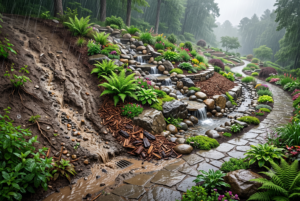
Blocked water doesn’t just disappear; it runs to the lowest point on a property. That’s how driveways get puddles, how basements stay damp, how erosion creates channels along foundations that homeowners often don’t see until the repairs are needed.
Layering Gravel the Right Way
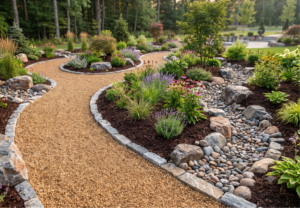
Permeable landscaping materials work in layers built to let water pass through rather than pool. A base of compactable crushed rock provides structure, while a top layer of eco-friendly gravel, like drain rock or pea gravel, keeps water moving downward.
| Layer | Material | Function |
| Base | Crushed rock (CSTC/CSBC) | Structural support, compacts for stability |
| Drainage | Drain rock | Moves water down and away from the surface |
| Surface | Pea gravel | Walkable finish that still allows infiltration |
Native Stone, Local Advantage
Stone is durable, but where it comes from changes how well it performs.
The Geology Behind a Longer-Lasting Driveway
Much of the crushed rock used across our region comes from blue-grey basalt sourced near Mt. Rainier, valued for its consistency and ability to compact tightly under a driveway. That’s a direct result of its mineral makeup, and part of why native stone landscaping performs better than mixed imported options in our freeze-thaw, rain-heavy environment.
Why Sourcing Local Actually Matters
Stone quarried close to home reaches a project faster, with fewer inconsistencies between loads. Serving Graham, Lakewood, Port Orchard, Gig Harbor, Steilacoom, Tacoma, and Bonney Lake, WA, our landscaping supplies come from quarries we know well, not distant sources, so projects move forward on schedule.
| Regionally Sourced Basalt | Imported Mixed Stone | |
| Compaction consistency | High, well-documented | Variable by batch |
| Delivery lead time | Shorter | Often longer |
| Freeze-thaw performance | Proven locally | Frequently untested here |
Reclaimed Wood, Renewed Purpose
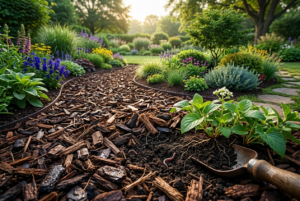
Landscape bark shields soil from sun and wind, slowing evaporation and reducing watering needs. As it breaks down, it returns organic matter to the soil, feeding the biology that gives the soil structure and absorbency. Cedar play chips perform a similar function in high-traffic areas, providing a renewable surface without adding synthetic material to a yard built around natural drainage.
Recycled Metal, Real Impact
There is a role for metal in edging, raised beds, and structural details. Weathering steel, which is often salvaged from industrial sources, forms a stable layer of oxide that protects the metal underneath. This means it lasts longer than untreated wood or plastic edging in wet climates. Choosing recycled metal garden materials diverts material from landfills while delivering a component that will outlast most others installed around it.
Plants as Building Materials
Plants are often treated as decoration while stone and soil are considered the real infrastructure, but that distinction doesn’t hold up. Deep-rooted native grasses and shrubs anchor soil on slopes in ways that no hardscaping material can replicate, and their roots create pore structure that keeps water moving downward. Compost and garden mix provide organic matter to help them establish faster and get to work within a season, if planted in properly conditioned soil.
One Material, One Season at a Time
Overhauling a property’s drainage in one weekend rarely works, and it isn’t necessary. Doing the work over the seasons helps each material settle before the next stage begins.
| Season | Focus | Why It Works |
| Spring | Soil conditioning, new plantings | Ground is workable, roots establish before summer heat |
| Summer | Permeable hardscaping installation | Dry conditions ease compaction and grading |
| Fall | Mulch and bark application | Protects soil structure through winter rainfall |
| Winter | Planning stone or structural additions | Time to source material for next year |
Building Ground That Works With the Weather
A resilient landscape is the sum of soil that filters instead of sheds, stone that compacts instead of shifting, permeable surfaces that let rain finish its natural cycle, and plants and reclaimed materials doing structural work most people never notice. Each strategy here addresses a point where water either gets absorbed or gets away, determining whether a property manages damage each winter or simply weathers the season.
We’ve supplied topsoil, gravel, bark, and landscape rock to homeowners and contractors across the South Puget Sound since 1987, and every recommendation here reflects what we’ve seen work on real properties. Whether you’re conditioning soil for a new bed, laying a permeable base, or sourcing native stone for a retaining wall, our team at Randles Sand & Gravel, Purdy Topsoil & Gravel, and Lynch Creek Quarry can help match the right material to your site.
If your property already shows signs of poor drainage, or you’re planning ahead of the next wet season, don’t wait for the problem to compound. Call us at (253) 531-6800, and our team will help you build a plan that starts with the right material, right from the beginning.