Introduction
The majority of people think about landscaping the same way they think about paint: Choose what looks good, slap it on, and move on. What they miss is that the materials beneath the surface are doing the real work: managing water, stabilizing soil, and either supporting or slowly undermining everything built on top. Impermeable yards destroy groundwater recharge cycles. Bare soil compacts and erodes under Pacific Northwest rainfall.
Landscapes built without drainage logic flood, sink, and damage foundations, problems that compound with every wet season you delay fixing them. The longer a property runs on the wrong landscape materials, the deeper the repair bill gets. At Randles Sand & Gravel, we’ve spent decades helping homeowners and contractors across the South Puget Sound build outdoor spaces that genuinely work, and this blog tells you exactly how to do the same.
This guide covers what eco-friendly landscape materials actually are, which options perform best for drainage and durability, how they apply to residential and commercial projects, and the critical mistakes that quietly undermine even well-intentioned sustainable landscaping plans.
What Are Eco-Friendly Landscape Materials?
Eco-friendly landscape materials go beyond aesthetics. Think of it this way: every material you lay down is either helping your soil breathe and drain, or quietly working against it. The options worth choosing are the ones that perform well through wet winters, don’t demand constant upkeep, and leave the ground beneath them healthier than they found it. That’s what separates a genuinely sustainable outdoor design from one that just looks the part on a sunny afternoon.
The Difference Between Sustainable and Just Natural
Not everything natural is sustainable. There are real environmental costs to quarrying virgin stone or shipping in decorative materials from hundreds of miles away. Genuinely eco-friendly gravel and aggregate come from responsible local sourcing and, increasingly, from recycling demolition waste back into usable material, which is exactly the approach that defines sustainable outdoor design done right.
Benefits of Using Sustainable Landscape Materials
The practical case for sustainable landscaping is stronger than most homeowners realize. Impermeable surfaces, solid concrete, standard asphalt, and packed clay prevent rainfall from filtering into the soil. Instead, it runs off the surface, picking up oil and chemical residue before flowing directly into storm drains. The University of Delaware’s Cooperative Extension says runoff reduces water quality, speeds up stream bank erosion, and drains groundwater aquifers faster than they can be replenished naturally.
Permeable landscaping materials reverse this pattern. They let water move through the surface, filter through soil layers, and recharge groundwater naturally. In Tacoma and Lakewood, where stormwater regulations are tightening, the difference between permeable and impermeable surfaces is often the difference between a functioning yard and a flooding one.
What covers the ground around your home determines how rainwater behaves after it falls. Choose wrong, and water becomes your most expensive problem.
Popular Eco-Friendly Landscape Material Options
Choosing the right material starts with understanding what each one actually does, not just what it looks like in a brochure. Here is a breakdown of the most effective options for sustainable outdoor design:
| Material | Primary Function | Sustainability Advantage |
| Drain Rock | French drains, drainage channels | High permeability, minimal processing |
| Crushed Basalt | Driveways, paths, sustainable hardscaping | Local sourcing, partial permeability |
| Pea Gravel | Surface drainage, walkways | Natural, requires minimal processing |
| Compost | Soil amendment | Reduces irrigation need, feeds soil biology |
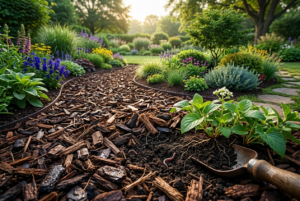
| Landscape Bark | Moisture retention, weed control | Organic, improves soil structure over time |
| Recycled Concrete | Base layers, structural fill | Diverts demolition waste, reduces quarrying |
Recycled concrete aggregate (RCA) is an underused option in low-maintenance landscaping. Studies cited by the Federal Highway Administration confirm that RCA performs on par with virgin aggregate for structural applications; it compacts well, drains freely, and keeps demolition waste out of landfills. Washington State recommended it as a substitute for natural aggregate as far back as 2009. We accept concrete, asphalt, and clean fill for recycling at our locations, so the material from your demo job can become the base of someone else’s project.
How Eco-Friendly Materials Improve Outdoor Drainage
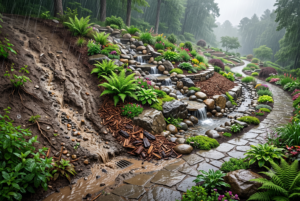
Most drainage failures aren’t design failures; they’re material failures. Properties in Steilacoom and Graham that rely on compacted soil or impermeable hardscaping have no real drainage system at all. When Pacific Northwest rain comes hard from October through April, water has to go somewhere. If it can’t go down, it goes sideways, into basements, under slabs, toward foundations.
A properly installed French drain, using drain rock and pipe bedding, intercepts water before it reaches structures, temporarily holding it in the void space while the soil below absorbs it. Pea gravel under downspout splash zones disperses concentrated roof runoff, reducing the erosion that builds against foundation walls over time. None of this is complex, but it requires choosing permeable landscaping materials deliberately, not defaulting to whatever is cheapest upfront.
Sustainable Landscaping Ideas for Residential Properties
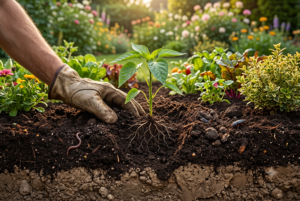
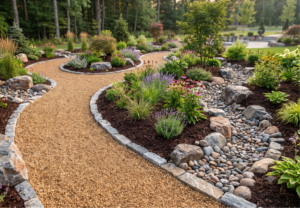
The Pacific Northwest climate rewards landscape plans that lean into permeability and organic matter. Decorative rock landscaping with washed round rock or river rock holds its appearance through wet seasons without the maintenance overhead of turf. French drain systems installed along fence lines and at the base of slopes redirect seasonal water away from structures before it can cause damage. Compost layered annually into garden beds rebuilds soil organic matter and dramatically reduces how much irrigation planting areas need. Landscape bark around established trees protects root zones from compaction and temperature swings.
Low-maintenance landscaping built on these materials doesn’t mean neglect; it means the materials are doing the work, so the property owner doesn’t have to.
Commercial Landscaping and Sustainable Material Trends
Commercial properties in Gig Harbor and Port Orchard are under increasing pressure to manage stormwater on-site. Many Washington municipalities now require drainage mitigation for impermeable surfaces beyond a certain square footage; ignoring this during a renovation creates real compliance exposure.
Sustainable hardscaping with permeable aggregate base layers addresses this at the structural level. Decorative rock landscaping in commercial entryways and medians eliminates turf that requires regular irrigation, mowing, and chemical inputs. These aren’t environmental gestures; they’re operational decisions that reduce overhead and extend the lifespan of exterior surfaces well beyond what impermeable alternatives can deliver.
How to Choose the Right Eco-Friendly Landscape Materials
Match material to function first; that is the rule, and most mistakes happen when it gets reversed. For drainage applications, use angular, open-graded drain rock or pea gravel. Round rock doesn’t interlock well enough to create reliable void space in drainage channels. For high-traffic surfaces, crushed rock with fine gradation compacts into a stable, load-bearing surface that pure decorative gravel cannot replicate. For soil health, reach for compost and organic bark, not decorative rock, which does nothing for soil biology and can block moisture infiltration if applied too densely.
Our landscaping supplies team across all three Randles locations can help you calculate quantities and match materials to your specific site conditions before you order, whether your project is in Bonney Lake, WA, Tacoma, or anywhere across the South Puget Sound.
Common Mistakes to Avoid in Sustainable Landscaping
Using fine materials for drainage is the most common error. Fine-grade gravel compacts under weight and loses its permeability quickly; true drain rock is angular and open-graded for a reason. Skipping a weed barrier under decorative rock means organic debris accumulates in the rock layer over time, creating a seedbed that’s nearly impossible to address without full removal. Underestimating quantity causes delays and visible inconsistencies in the finished surface. Always calculate before ordering, or call our team for help. And never install permeable materials without first verifying the surrounding grade directs water away from structures, not toward them.
The Ground Beneath Everything
The right eco-friendly landscape materials change how a property functions across every wet season for years to come. Drain rock that redirects water away from a foundation prevents structural damage. Compost-rich soil that absorbs rainfall reduces erosion. Crushed rock surfaces handle Pacific Northwest winters without cracking or flooding. These aren’t cosmetic decisions; they’re the foundation everything else is built on.
Randles Sand & Gravel has been a leading supplier of landscape materials in the South Puget Sound since 1987. With three locations and a full delivery fleet, we serve homeowners and contractors across Tacoma, Lakewood, Gig Harbor, Port Orchard, Steilacoom, Graham, and Bonney Lake, WA with quality landscaping supplies at competitive prices, from drain rock and crushed basalt to compost, landscape bark, and recycled aggregate.
Call us at (253) 531-6800 to talk through your project. Our team is available Monday through Friday and Saturdays, ready to help you get the right materials to the right place.