An Introduction
Choosing the wrong ground cover is one of those mistakes that doesn’t announce itself immediately; it compounds. A mismatched material will shift when it’s under load, will channel water toward your foundation, not away from it, and will look bad in a season or two. What looked like a smart shortcut becomes a full redo. The difference between a landscape that holds and one that fails often comes down to one decision made early: black crushed rock or traditional gravel.
At Randles Sand & Gravel, we’ve helped homeowners and contractors across the South Puget Sound make that call correctly for decades, and we carry both.
This blog goes through what each material really is, how they perform differently in real conditions, and which one belongs in your specific project. Before you know it, you’ll know what to order and why.
What Is Black Crushed Rock?
Black crushed rock is mechanically fractured stone, broken down from larger rock into angular, jagged pieces with a dark, near-black finish. The angular edges are the defining feature. When compacted, they interlock and create a surface that resists shifting under load. But most rounded materials aren’t like that.
What Makes It Different at a Material Level
The dark color comes from the mineral composition of the source rock, typically basalt or similar dense volcanic stone. But it’s not just about aesthetics: that density matters. Basalt-based black crushed rock is harder, heavier, and more resistant to breakdown than softer sedimentary alternatives. When you compact it properly, it almost forms a structural layer.
What Is Traditional Gravel?
Traditional gravel is naturally rounded stone, shaped over time by water and weathering rather than by machinery. The smooth edges are what distinguish it from crushed rock, and those smooth edges have real functional consequences. Without interlocking angles, rounded decorative gravel doesn’t bind under pressure. It shifts.
The Range Within “Traditional Gravel”
Not all traditional gravel is the same. Pea gravel, drain rock, concrete aggregate, and washed round rock all fall under this category but behave differently depending on size, wash level, and application. Washed products are better than unwashed products for drainage applications because the voids between pieces are open and free of fine particles.
The material that looks right and the material that performs right are sometimes the same thing, but only if you know the difference before you order.
Appearance Comparison: Modern vs Traditional Landscaping
| Feature | Black Crushed Rock | Traditional Gravel |
| Color | Deep black to dark charcoal | Grey, tan, buff, mixed earth tones |
| Texture | Angular, jagged | Smooth, rounded |
| Aesthetic | Modern, bold, high-contrast | Natural, organic, relaxed |
| Plant contrast | High: sharp against greenery | Moderate: blends with surroundings |
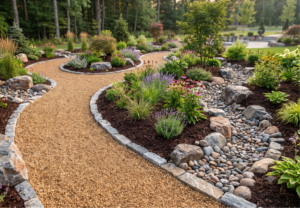
Black crushed rock reads as intentional and contemporary; it works for clean-lined modern homes, formal garden beds, and commercial properties where precision matters. Decorative stone landscaping with a traditional gravel look is natural and casual, fitting cottage gardens and rural properties where a softer look is the goal.
Drainage Performance and Functionality
This is where most people get surprised. Both materials drain, but they drain differently, and misunderstanding this leads to pooling, erosion, and structural damage that could have been avoided entirely.
Black crushed rock creates consistent void space between angular pieces. That space allows water to move through, but when the material is heavily compacted, which is exactly what makes it structurally stable, those voids close. A compacted crushed rock driveway is solid and load-bearing. It is also less permeable than a loose bed of gravel. These are trade-offs, not weaknesses, but they matter depending on where you’re putting the material.
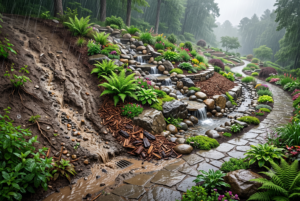
Washed traditional gravel, particularly drain rock and round rock, actually maintains higher permeability over time because rounded surfaces don’t pack as tightly. This is often the best option for French drains, pipe bedding, and drainage channels. This allows water to pass through easily without the risk of compaction.
The Rule Nobody Tells You
Drainage performance is only as good as the grade beneath the material. Even the best outdoor landscape materials will pool if the base isn’t sloped correctly. The material choice matters, but so does the prep work before it goes down.
Durability and Maintenance Comparison
Neither material rots or degrades like organic mulch; that’s the baseline advantage of any stone landscape rock. But durability plays out differently depending on traffic and site conditions.
Black crushed rock densifies over time. In driveways and high-traffic paths, that’s an asset; the surface firms up rather than loosening. Weeds have a harder time getting a foothold on compacted crushed stone, especially with a barrier below. The same compaction in decorative beds means less topping up.
Traditional gravel migrates. On slopes, under foot traffic, or along edges without solid containment, it moves. This isn’t a dealbreaker, but it is a maintenance reality: Rounded landscape gravel supply requires periodic redistribution and replenishment in ways that crushed rock typically doesn’t.
Best Uses for Black Crushed Rock
Crushed rock landscaping consistently outperforms traditional gravel in applications that demand structural stability:
Driveways and vehicle-load areas.
Formal pathways and hardscaping sub-bases.
Modern decorative beds where weed suppression and bold contrast are priorities.
Slope stabilization and erosion control.
Any surface where shifting is a functional problem, not just an aesthetic one.
How to Choose the Right Material for Your Landscape Project
The decision comes down to three questions, and answering them honestly will save you from a redo.
Does the surface take load or stay decorative?
Load-bearing applications, driveways, paths, and patios need the structural stability of black crushed rock. Both materials can be used in decorative beds and low-traffic areas.
Is drainage the primary objective?
Washed, rounded traditional gravel maintains better long-term permeability in drainage-specific applications. It’s often the more reliable call for drain trenches and pipe bedding.
What does the landscape need to look like?
Modern, high-contrast decorative stone landscaping calls for black crushed rock. Natural, relaxed gravel landscaping ideas that blend with surrounding plantings lean toward traditional gravel in earth tones.
If you’re weighing landscaping materials for a project in Graham, Lakewood, Port Orchard, Gig Harbor, Steilacoom, Tacoma, or Bonney Lake, WA, our team can help you match the right product to the actual conditions of your site, not just a general recommendation. We carry both materials and know how each one performs in the Pacific Northwest’s specific soil and rainfall conditions. Getting this wrong means redoing it. Getting it right means a landscape that holds for years.
The Right Choice Lasts. The Wrong One Costs You Twice.
Black crushed rock and traditional gravel solve different problems. Crushed rock holds structure, resists shifting, and delivers a bold modern finish. Traditional decorative gravel provides natural drainage, organic aesthetics, and flexibility in decorative applications. Neither is always better, but one is certainly better for your specific project, and that distinction is more important than most people realize before the material is already in the ground.
Randles Sand & Gravel has been supplying quality outdoor landscape materials across the South Puget Sound since 1987. We carry black crushed rock, washed gravel products, landscape rock, topsoil, bark, compost, sand, and more, with three locations in Puyallup, Gig Harbor, and Eatonville, and delivery available throughout the region. Our team knows the material and the local conditions, and we’ll give you a straight answer before you order.
Call us at (253) 531-6800, we’ll help you choose the right material and make sure it gets to you.