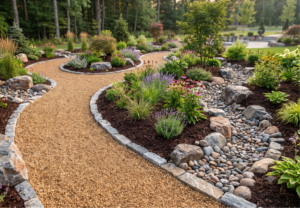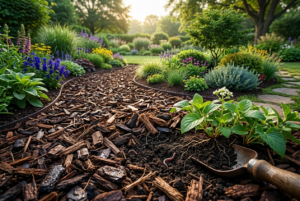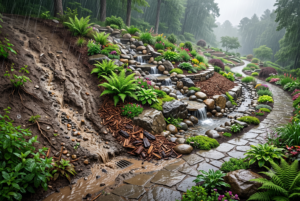
Spend any time driving through well-kept neighborhoods in Tacoma, Gig Harbor, or Lakewood, and a pattern starts to emerge. The properties that look the sharpest often have the same thing in common: clean, neutral ground cover that does not compete with the rest of the landscape. No garish colors, no materials that shift underfoot, no ground cover that needs replacing every spring.
More often than not, that material is blue-grey crushed rock. And it has earned that spot not because it is trendy, but because it genuinely works. It holds up through Pacific Northwest winters, drains well, compacts firmly, and looks appropriate whether the property is residential, commercial, or somewhere in between.
The U.S. Geological Survey reports that crushed stone is one of the most widely used construction materials in the country, with production exceeding 1.5 billion tons each year. That level of demand reflects decades of real-world performance, not marketing. For anyone searching for a landscape rock supplier near me, understanding why this particular material keeps showing up on well-maintained properties is a good place to start.
Understanding Blue Grey Crushed Rock
What Makes It Distinct
- The angular shape is what sets blue-gray landscape rock apart from rounded alternatives. Those jagged edges lock together under pressure, which is why the surface stays put instead of shifting over time.
- Color-wise, the cool, muted tone sits well alongside most architectural styles without competing for attention.
- They carry it in a few different size grades, so whether you need fine material for a garden border or something heftier for a driveway base, there is always something that fits.
- A good landscape rock supplier near me keeps multiple grades on hand, so you never feel pressured to settle just because of what happens to be in stock.
Where It Is Commonly Used
| Where It Gets Used | Why It Actually Works | Best Rock Size |
| Driveways | Angular edges pack down tight and handle the weight of vehicles coming and going | 3/4″ to 1.5″ crushed |
| Walkways & Pathways | Gives you a firm, slip-resistant surface that drains well underfoot | 3/8″ to 5/8″ crushed |
| Garden Beds | The grey tones sit nicely alongside greenery without stealing the show | Pea-size or 3/8″ |
| Drainage Areas | Water moves through freely so you’re not dealing with puddles after every rain | 3/4″ clean drain rock |
| Base Layers | Builds a solid foundation that keeps everything sitting level over time | 1.25″ to 1.5″ crushed |
Quick Tip
Smaller sizes work well for garden pathways and decorative beds, while larger crushed aggregates make more sense for base layers and drainage work, where performance matters much more than appearance.
Visual Appeal That Elevates Every Space
Why Designers Prefer Blue Grey Tones
A property’s ground cover sets the visual tone for everything above it. Landscapes that use blue grey crushed rock tend to look cohesive and intentional because the color sits in that useful middle ground between warm and cool tones. It does not clash with brick, timber, concrete, or painted surfaces. It reads as neutral without looking flat, and it holds its color over time, unlike many alternatives.
In Port Orchard, homeowners regularly use this material as decorative gravel for gardens to create contrast alongside plantings without overwhelming them. In Steilacoom, the same material defines pathways and outdoor seating areas in a way that feels considered rather than constructed. Across the South Sound, it adapts to the setting rather than dictating it.
Blue Grey Rock vs Traditional Options
| Feature | Blue Grey Crushed Rock | Traditional Brown Gravel | Why It Matters |
| Aesthetic Appeal | Clean, modern look with a neutral tone that blends easily | Warmer, rustic feel with more color variation | Sets the overall tone of the property |
| Color Consistency | Holds its color and stays fairly uniform over time | Can fade unevenly or look patchy as it ages | Important if curb appeal is a priority |
| Compaction | Angular pieces lock together tightly for a solid surface | Rounded stones tend to shift and move under pressure | Directly impacts surface stability |
| Drainage Performance | Open structure allows water to pass through easily | Performance varies depending on the mix | Becomes critical during heavy rain |
| Versatility | Fits well with both modern and mixed landscape styles | Best suited for more natural or informal designs | Affects how flexible it is across different uses |
Performance That Goes Beyond Appearance
1. Functional Benefits
The visual case for blue grey crushed rock is straightforward, but the performance case is what tends to convert contractors and property managers who need materials that hold up over years, not just seasons.
2. Drainage:
As a drainage rock for landscaping, the open aggregate structure of this material allows water to pass through rather than pool on the surface. The Environmental Protection Agency identifies proper ground permeability as a key factor in managing stormwater runoff and reducing erosion risk. In a region that sees rainfall levels like those in the Pacific Northwest, this is not a minor consideration.
3. Traction:
The angular texture that gives this rock its compaction strength also provides meaningful grip. On crushed rock pathways and walkways, this matters particularly in wet weather, when smoother surfaces become slippery and dangerous.
4. Longevity:
Unlike bark mulch or compost-based ground covers, crushed rock does not break down, blow away, or require seasonal replacement. Once it is placed correctly, it largely stays where it is put.
Performance Snapshot
| Benefit | How It Shows Up on Your Property | Relevant For |
| Effective Drainage | Helps prevent pooling and waterlogging after heavy rain | All South Sound properties |
| Surface Traction | Provides a stable, slip-resistant surface in wet conditions | High foot traffic areas |
| Long-Term Stability | Holds its shape under regular vehicle and foot traffic | Driveways, commercial sites |
| Low Maintenance | Doesn’t require frequent replacement or ongoing treatment | Residential and rental properties |
A Smarter Alternative to Traditional Ground Covers
Why More Property Owners Are Switching
More property owners across the South Sound are moving away from organic ground covers, and the reasons are practical rather than aesthetic.
- The annual cycle of mulch top-ups, decomposition, and weed pressure adds up in both time and cost, and low-maintenance landscape rock eliminates most of that entirely.
- The upfront cost of crushed rock can be slightly higher, but the long-term picture is considerably more economical when replacement and labor costs are factored in
- The U.S. Department of Energy has noted that landscaping choices that affect water use and maintenance frequency have a measurable impact on resource consumption over time.
- Properties that switch from organic mulch to inorganic ground cover, like crushed rock, typically see a meaningful reduction in both water use and ongoing maintenance labor.
Rock vs Mulch: A Practical Comparison
| Factor | Blue Grey Crushed Rock | Organic Mulch | Practical Impact |
| Lifespan | Lasts indefinitely with only occasional top-ups | Breaks down within 1 to 2 years | Lower long-term maintenance costs |
| Maintenance | Needs occasional raking or a light top-up | Requires yearly or twice-yearly replacement | Fewer maintenance cycles throughout the year |
| Drainage | Performs reliably in all seasons | Can compact over time and slow water flow | Especially important in areas with heavy rainfall |
| Pest & Weed Risk | Less likely to attract pests or hold weeds | Retains moisture, which can attract pests and weeds | Reduces the need for spraying and constant weeding |
| Long-Term Cost | More cost-effective with minimal upkeep over time | Adds up due to frequent replacement | Noticeable savings over 5+ years |
Key Takeaway:
If you want a landscape that looks sharp year-round without a lot of upkeep, crushed rock brings durability and a cost profile that organic materials honestly just cannot compete with over a five-year period or longer.
Installation Guidance for Optimal Results
Good installation is really what separates a surface that holds for years from one that shifts and settles within a season. The material itself only performs as well as the preparation beneath it.
Step-by-step overview:
- Start by prepping and leveling the surface so you’re not left with low spots where water can collect down the line.
- Install a quality base layer if the application involves vehicle weight or needs structural support.
- Lay landscape fabric to suppress weed growth without blocking drainage through the aggregate.
- Spread the rock evenly to the recommended depth for the application, typically 2 to 3 inches for pathways and 4 or more for driveways.
- Compact for stability, particularly for driveways and high-traffic areas, to lock the surface in place.
Before you start, confirm the following:
- Measured area and volume so your order covers the job without a second trip
- Correct rock size selected for the intended application and traffic level
- Drainage slope accounted for, especially on level or low-lying ground
- Delivery is scheduled to align with your installation window, so the material does not sit in the way of other work
Common mistakes to avoid:
- Skipping base preparation on driveways, which leads to surface depression over time
- Choosing rock size by appearance rather than function
- Overlooking drainage requirements, particularly on clay-heavy soil common across parts of the South Sound
Why Professionals Source from Randles Sand & Gravel
Material quality matters, but so does the confidence that what was ordered will arrive on time and in the right quantity. For contractors managing crushed rock for driveways in Tacoma or coordinating larger landscape installations across Graham, Lakewood, and Bonney Lake, WA, a supplier who understands the region is worth more than one who simply has stock available.
Randles Sand & Gravel has operated across the South Sound since 1987. Our familiarity with local soil conditions, project timelines, and the specific demands of Pacific Northwest landscaping rock applications means our guidance is grounded in practical experience rather than product sheets.
What contractors value about working with them:
- Consistent material quality that does not vary between orders
- Reliable blue grey crushed rock delivery that aligns with project schedules rather than forcing crews to wait
- Regional knowledge that covers communities from Port Orchard and Gig Harbor through to Steilacoom and beyond
- Staff who can help size an order correctly from the start, reducing waste and unnecessary follow-up deliveries
Final Thoughts: A Material That Balances Form and Function
Blue grey crushed rock has become the default choice for serious landscaping work across the South Sound because it earns that position every season. It handles the wet winters that test drainage systems. It holds firm under the foot and vehicle traffic that softer materials give way to. And it looks appropriate on everything from a residential garden path to a commercial property entrance, without requiring the ongoing attention that organic ground covers demand.
If you’re a property owner or contractor in Tacoma, Gig Harbor, or Bonney Lake, WA, Randles Sand & Gravel has the quality of materials and delivery reliability you need for this kind of work. Planning a landscape project and want to get the material selection and timing sorted from the start? Get in touch with our team to talk through your order and schedule delivery of blue-grey crushed rock.