Bark mulch begins to decompose the moment it hits the ground, and in the Pacific Northwest, it never even has a chance to dry out first. Each wet season, organic ground cover compacts into a soggy mat, weeds poke through the rotting layer, driveways rut under tire pressure, and drainage backs up against foundations. Homeowners patch it, top-dress it, and replace it season after season, spending money on a material that is, by design, temporary. Meanwhile, standing water quietly damages subgrades, accelerates erosion, and finds its way toward foundations in ways that aren’t visible until the repair bill arrives. The problem isn’t the Pacific Northwest climate; it’s using the wrong material for it.
At Randles Sand & Gravel, we’ve been watching this play out since 1987, and we have a better answer.
This blog breaks down everything homeowners and contractors need to know about blue-grey crushed rock: what makes it structurally different from ordinary gravel, why it performs exceptionally well in Pacific Northwest yards, how it honestly compares to mulch, and the installation details that determine whether it works long-term or not.
What Makes Blue Grey Crushed Rock Different From Regular Gravel?
The words gravel and crushed rock are used by most people interchangeably. They are not the same material, and the difference has direct implications for performance.
1. The Geometry That Changes Everything
Natural gravel is rounded, water-smoothed over thousands of years, so the particles have nothing to grip onto. Stones, rounded, roll against each other, shift, migrate, and sink under pressure. Put weight on rounded gravel, and it ruts. It walks itself down a slope in a rainstorm.
Blue-grey crushed rock is mechanically fractured. Each piece has sharp, irregular edges that physically interlock with adjacent pieces when compacted, creating a stable matrix that resists movement under load. That’s not aesthetics, that’s physics. This interlocking geometry is why crushed rock for driveways outperforms rounded gravel under vehicle traffic, and why contractors consistently specify it for base layers.
2. Where Randles’ Blue Grey Rock Comes From
Our blue-gray landscape rock is quarried basalt from Lynch Creek Quarry in Eatonville, WA, a source supplying some of the best rock products in the Pacific Northwest for more than half a century. Basalt is a dense, volcanic rock that hardens as it weathers rather than breaking down. When wet, the blue-grey color becomes deeper, so the look of the material is enhanced in the rainy season, not diminished. We carry it in multiple sizes, from ⅝” minus for driveways and compacted base layers, to clean sizes for drainage, to quarry spalls for slope stabilization, one consistent source material for multiple functional applications.
Why Blue Gray Landscape Rock Looks Right in Pacific Northwest Yards
The Pacific Northwest’s natural palette, Douglas fir green, overcast grey sky, dark cedar, wet stone, doesn’t pair with warm-toned or high-contrast materials. The tan gravel looks out of place here. The blue-gray landscape rock reads native because it is. The basalt that defines the Cascades is the same volcanic geology that produced the color behind this material.
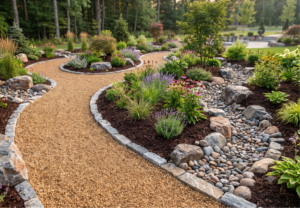
Against dark wood fencing, concrete, or ornamental grasses, it ties the yard together without competing. It also ages visually without decaying; an installation from five years ago will look much the same as one from last spring, something no organic material can claim. Used as decorative gravel for gardens, it adds depth without a busy pattern. On crushed rock pathways and walkways, the angular surface provides grip underfoot during the wet months when smooth surfaces become genuinely hazardous.
Worth knowing: Most landscape materials are chosen for how they look on day one. The ones worth investing in are chosen for how they perform on day 500.
The Performance Numbers That Make Drainage Rock for Landscaping Worth It
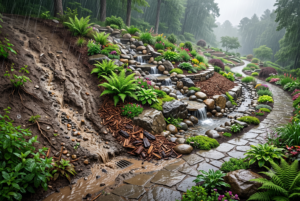
In a climate where seasonal rainfall is measured in feet, ground cover that manages water poorly doesn’t just look bad; it creates compounding structural damage.
| Performance Factor | Rounded Gravel | Angular Crushed Rock |
| Compaction under load | Shifts and ruts | Interlocks and holds |
| Slope stability | Migrates downhill | Holds position when compacted |
| Longevity | Degrades over time | Structurally stable for decades |
| Weed suppression (with fabric) | Moderate | Strong |
Using proper drainage rock for landscaping from the start costs a fraction of what it takes to remediate water pooling against foundations, subgrade erosion beneath driveways, and bed failures that require complete removal and reinstallation. That’s not hypothetical; that is what the deferred decisions on ground cover ultimately produce.
Low Maintenance Landscape Rock vs. Mulch: An Honest Comparison
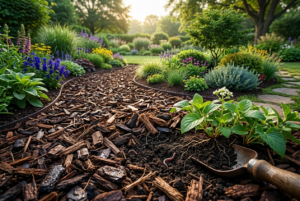
Bark mulch needs replacing every one to two years. In the Pacific Northwest, that cycle often runs shorter, saturated mulch rots, loses weed-suppression ability, and develops mold against structures. Decomposing organic mulch also attracts insects that don’t stay in the yard.
Low-maintenance landscape rock doesn’t decompose, rot, compact into soil, or feed weeds. A properly installed rock surface lasts ten to fifteen years or more with occasional debris removal. All the math over the years points to rock, even with the higher up-front cost, the annual replacement cycle just stops.
Where mulch still makes sense: active planting beds where soil health matters and seasonal plant rotation demands flexible ground cover. The strongest landscapes use both Pacific Northwest landscaping rock in permanent zones and mulch in changing beds.
The real question isn’t rock or mulch, it’s which areas of your yard are permanent, and which ones are going to change. Install accordingly.
How to Install Blue Grey Crushed Rock So It Actually Performs
The material only performs as well as the preparation beneath it.
- For driveways: Excavate 4 to 6 inches below the finished grade and slope the subbase for drainage. Use a plate compactor to compact a base layer of ⅝” minus crushed rock before placing the finish layer. Skipping straight to the surface layer without a compacted base is the most common reason crushed rock for driveways fails in residential installations.
- For pathways and walkways: Excavate 3 to 4 inches, lay non-woven geotextile fabric to separate rock from soil, install 2 to 3 inches of ⅝” minus, and add rigid edge restraints. Crushed rock pathways and walkways without edge containment spread laterally over time, regardless of how well the base is compacted.
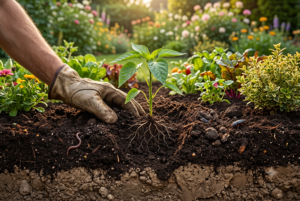
- For garden beds: Clear existing vegetation, apply woven landscape fabric, not plastic sheeting, and install 2 to 3 inches of rock over the fabric, keeping material away from plant stems and tree trunks.
The Installation Mistake That Wastes Your Investment
Plastic sheeting under rock is the most consequential installation error we see. It blocks water entirely, kills soil biology, and ultimately fails, creating uneven settling that requires pulling up the entire installation and redoing it. The second mistake is skipping fabric altogether and laying rock directly on native soil. In the clay-heavy ground common across Graham, Lakewood, and much of the South Sound, the rock sinks over time.
The fabric layer is not optional; it’s what keeps the separation between your rock surface and the subgrade that keeps the installation performing as it should, years after it’s done.
Why Randles Is the Landscape Rock Supplier Near Me That Contractors Trust
We’re not a distributor. We operate our own quarry at Lynch Creek, which means we control what comes out of it. The blue grey crushed rock we supply is consistently the same material, same color, same angularity, same compaction behavior, because it comes from the same basalt source we’ve worked for decades.
We have three locations across the South Puget Sound: Randles Sand & Gravel in Puyallup, Purdy Topsoil & Gravel in Gig Harbor, and Lynch Creek Quarry in Eatonville. That puts us within reach of homeowners and contractors across Tacoma, Port Orchard, Steilacoom, Bonney Lake, WA, and the surrounding region. We have a full fleet of trucks with experienced drivers, customers have publicly said that our deliveries are accurate, even to difficult sites. When you need blue grey crushed rock delivery, that dependability matters. Want to come pick it up? Our retail yards are set up to make it easy.
When contractors search for a landscape rock supplier near me, they tend to call us first. We’ve been consistent since 1987, and in this business, that’s not a coincidence.
The Right Rock Makes All the Difference
Blue grey crushed rock performs where other ground cover materials fail: it compacts, drains, holds under load, and endures wet Pacific Northwest seasons without a replacement cycle. Installed correctly with proper base preparation and fabric separation, it’s a one-time investment that holds up for a decade or more. Picking the wrong ground cover for this climate is not a minor inconvenience; it’s a recurring expense that compounds quietly until the damage is visible.
At Randles, we source our blue grey basalt from our own Lynch Creek Quarry and deliver it across Tacoma, Gig Harbor, Graham, Lakewood, Port Orchard, Steilacoom, and Bonney Lake, WA. With three locations, a reliable delivery fleet, and a team that understands the material they’re selling, we support projects of every scale, from a weekend driveway refresh to a full commercial installation.
Call us at (253) 531-6800, stop by one of our locations, or reach out through our website. We will help you find the right product and right quantity for your project and have it shipped right to your doorstep.