Most yards don’t fail because of bad seeds, poor watering, or the wrong fertilizer. They fail because the wrong type of soil was laid down before any of that even started. Once you’ve put topsoil in the wrong layer, roots can’t get through, water pools instead of draining, nutrients get locked out, and the surface above begins to tell you about it through patchy grass, dying beds, and soft ground that never quite firms up. By the time most homeowners connect the dots, they’ve already spent a full season fighting the symptoms of a problem buried 6 inches below the surface.
The good news: at Randles Sand and Gravel, we’ve been helping South Sound homeowners get this right since 1987, and the fix almost always starts with one simple question: screened or unscreened?
This blog breaks down the real difference between screened vs unscreened topsoil, which type belongs where, how to choose the right topsoil for landscaping projects of any size, and exactly how to calculate what you need before you order. Read through once, and you’ll never second-guess a topsoil decision again.
What Is the Real Difference?
Most people think topsoil is topsoil. It isn’t. Those two types do very different jobs, and confusing them is how projects go wrong.
- Screened Topsoil
Screened topsoil is run through a mesh, typically a ½-inch to ¾-inch screen, that filters out rocks, roots, sticks, and large clumps. What remains is a fine, uniform growing medium. Because the particles are consistent in size, water moves through it evenly, roots penetrate it freely, and amendments like compost blend into it without pockets or voids. The screened topsoil benefits aren’t just cosmetic. That’s the texture that lets seeds come into contact with soil, germinate evenly, and settle in without having to fight their way through debris. It also lets nutrients go to the roots instead of being blocked by uneven particle sizes.
- Unscreened Topsoil
Unscreened topsoil is freshly stripped from the source, with its natural makeup intact: variable particle sizes, some rocks, organic debris, and structural bulk. This isn’t a flaw; it’s a function. Unscreened topsoil for fill applications depends on the bulk and variability. Under compaction, the irregular particles interlock and create structural mass. That’s just what you want under a finished grade, not on top of one.
| Screened Topsoil | Unscreened Topsoil | |
| Texture | Fine, uniform | Variable, natural |
| Debris | Removed | Present |
| Root penetration | Excellent | Poor at surface |
| Best application | Surface layer | Sub-layer / fill |
| Compaction behavior | Minimal | Solid under load |
Putting unscreened topsoil where screened belongs is like pouring concrete on your garden bed, nothing useful gets through.
Screened Topsoil: When Surface Quality Is Everything
Any project where something is going to grow, spread, or establish itself at the surface level demands screened topsoil. The screening process provides a medium where nutrients are spread evenly, oxygen can move freely between particles, and moisture retention is consistent, not hit-or-miss. Without this, roots hit irregular pockets, air and water movement stall, and the ground above starts showing stress signs that no amount of fertilizer or watering will fix.
Screened Topsoil Benefits Apply Most When You’re Tackling
- Best topsoil for new lawn installation: Grass seed needs direct soil contact to germinate evenly. Screened topsoil’s fine texture eliminates the gaps and debris that cause patchy, inconsistent establishment. For new lawns, a minimum of 4–6 inches of screened topsoil is the standard.
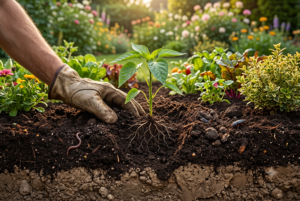
- Topsoil for garden beds: Plants with delicate root systems, especially vegetables and flowers, cannot push through rocks or hard debris. Screened topsoil provides them a clean medium to spread through and always reach nutrients.
- Top-dressing and overseeding: Thin, even application over an existing lawn only works if the material spreads cleanly. Screened topsoil does. Unscreened will not.
- Finish grading: Screened topsoil controls what unscreened material cannot enter to ensure the final surface layer drains properly and looks level.
Homeowners in Gig Harbor, Steilacoom, and Port Orchard tackling front lawn renovations or garden installations will almost always be working in this category.
Unscreened Topsoil: The Workhorse Nobody Talks About
Unscreened topsoil is not inferior; it is just misunderstood. Its value is all in what it does below the surface. The variable particle sizes and natural debris that make it a poor growing medium actually make it structurally superior for fill work. When compacted, those irregular particles lock together to create a stable mass. That’s not a problem, it’s the point.
Where Unscreened Topsoil for Fill Makes Perfect Sense
- Topsoil for new construction yard projects: New builds almost always strip or disturb existing soil during construction. Before any finish grade or lawn can be established, the volume needs to be built back up. That’s unscreened territory.
- Rough grading and low-spot correction: Large depressions, erosion damage, or significant grade changes need volume first. Unscreened topsoil handles the bulk efficiently before screened material goes on top.
- Berms and structural mounds: The natural composition and compaction behavior of unscreened topsoil make it the right material for shaping land rather than finishing it.
- Sub-base layers: Beneath hardscaping, pathways, or any surface that requires a stable sub-layer, unscreened topsoil can be compacted into a reliable base.
Homeowners across Graham, Bonney Lake, WA, and Tacoma, dealing with post-construction bare lots or significant grading work, typically move large volumes of unscreened material before a single bag of seed gets opened.
Think of it this way: unscreened builds the foundation, screened finishes the job. Skip one or mix them up, and you’ll be redoing both.
Project-by-Project: How to Choose the Right Topsoil for Landscaping
The decision isn’t complicated once you know the layer. Ask one question first: is this going on top, where it will grow and be seen by others, or below, where it must hold shape?
Surface layer = screened. Sub-layer and fill = unscreened. Hybrid projects need both, in that order.
How Much Topsoil Do I Need?
The question of how much topsoil I need is where most homeowners either under-order and run short mid-project or over-order and waste material. The calculation is not difficult:
Length (ft) × Width (ft) × Depth (inches) ÷ 324 = Cubic Yards
A 25×40 foot lawn area with 4 inches of screened topsoil needs approximately 12.3 cubic yards. Round up slightly; running short means a second delivery, which will always cost more than ordering the first time correctly. Our team is glad to help you work through the numbers before you order. Just call.
A Quick Project Reference
| Project Type | Recommended Topsoil | Depth Guideline |
| New lawn (seed or sod) | Screened | 4–6 inches |
| Garden beds | Screened | 6–8 inches |
| New construction rough grade | Unscreened | As needed to grade |
| Finish layer over rough grade | Screened | 4–6 inches |
| Top-dressing existing lawn | Screened | ¼–½ inch even layer |
| Berms / structural fill | Unscreened | Project-dependent |
When you’re searching for a topsoil supplier near me in the South Sound, what matters isn’t just availability; it’s whether the supplier actually knows the material well enough to tell you which type fits your project before the truck backs up. That’s a conversation we’ve been having with homeowners in Lakewood, Tacoma, Gig Harbor, Port Orchard, Steilacoom, Graham, and Bonney Lake, WA, since 1987. Bulk topsoil delivery in the South Sound is something our fleet handles daily, and our drivers know how to get material exactly where it needs to go.
The Bottom Line on Getting Your Soil Right
Topsoil is the base of everything that grows or stands on your property. Get it right, and your lawn establishes cleanly, your garden beds produce season after season, and your grades hold firm. Get it wrong, though, put unscreened material in a growing layer or skip the fill step before placing finish grade, and you’ll spend years managing problems that started below the surface on day one. Roots will struggle to penetrate, water will pool, nutrients won’t reach where they’re needed, and no amount of surface-level effort will undo what’s happening underneath.
At Randles Sand and Gravel, we carry both screened and unscreened topsoil, stock a full range of landscape materials, and offer bulk topsoil delivery South Sound homeowners and contractors rely on for residential and commercial projects of every size. Three locations, Randles Sand & Gravel in Puyallup, Purdy Topsoil & Gravel in Gig Harbor, and Lynch Creek Quarry in Eatonville, mean there’s always someone close by with the right material ready to go.
Don’t guess on the foundation of your project. Call our team directly at (253) 531-6800, walk us through what you’re working on, and we’ll make sure you order the right material, at the right quantity, delivered right where you need it.