An Introduction
People who end up with a failing lawn, a struggling garden, or an unstable construction yard all have one thing in common: they ordered topsoil without knowing that there are two very different types of topsoil. If you use the wrong type, you don’t just slow down your project; you damage it. Grass seed won’t germinate evenly. Garden roots hit rock and debris and stop growing downward. Construction yards settle unevenly, creating drainage problems and structural issues that cost far more to fix than the soil itself ever did. The longer the wrong soil stays in place, the more difficult and costly it is to fix.
At Randles Sand & Gravel, we’ve been helping homeowners and contractors across the South Sound get this decision right since 1987, and it starts with knowing exactly what you’re ordering.
This blog breaks down the real difference between screened vs. unscreened topsoil,
including what each one is, when each one is useful and when it isn’t, how to choose the right soil for your project, and how to figure out how much you need before you order.
What Is Screened Topsoil?
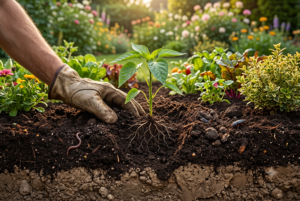
Screened topsoil begins as natural topsoil, the dark, biologically active upper 5 to 10 inches of the earth. It is then run through a mechanical mesh system to remove rocks, roots, clumps, sticks, and other debris. The sizes of screening mesh are usually between ⅝ and ¾ of an inch, which makes a fine, even, and easy-to-work-with material.
The soil that is left over after screening isn’t just cleaner; it’s also structurally better. The particles are all the same size, which makes the texture friable: loose, airy, and easy for roots to get into from every direction. This matters enormously because roots forced to navigate debris don’t grow downward; they spread laterally along the surface, where they can’t access deep moisture or nutrients. That’s the direct path to patchy lawns and poor plant development, regardless of how much water or fertilizer you apply afterward.
Because particles are uniform, water and nutrients also distribute evenly through the soil column rather than pooling around dense clumps. Amendments like compost and fertilizer integrate far more consistently, too, meaning every square foot of your garden or lawn receives the same treatment. At Randles, we offer purpose-built screened blends: Lawn Mix, Garden Mix, and Commercial Mix, each formulated for specific planting needs.
What Is Unscreened Topsoil?
Unscreened topsoil is natural soil delivered in its raw, unprocessed state. It retains its original composition: rocks, roots, organic debris, and clods included. This doesn’t make it an inferior product. It makes it a different product, built for a different purpose.
Because unscreened topsoil is denser and heavier, it compacts firmly under pressure — exactly what you need when establishing a stable base layer beneath grade. The debris it contains is irrelevant when the soil is going several feet below the surface for fill volume and elevation work. Ordering screened topsoil for this purpose wastes a refined, processed product on an application that simply doesn’t require it.
What most buyers never hear: The difference between screened and unscreened topsoil isn’t just visual, it’s structural. Not only does the wrong choice look bad, but it is also bad. It quietly fails your project from the ground up.
Screened Topsoil: Best Uses and Benefits
If something is being planted in it, it almost always belongs in screened topsoil. The screened topsoil benefits come down to one core advantage: consistency at the surface translates directly into performance above it.
| Project | Why Screened Works |
| New lawn from seed | Even texture ensures uniform seed-to-soil contact for consistent germination |
| Sod installation | Smooth, gradable surface creates an even, stable base |
| Vegetable/raised garden beds | Fine texture allows roots to penetrate freely and nutrients to distribute evenly |
| Flower beds and borders | Easy to amend uniformly with compost or fertilizer |
| Top-dressing existing lawns | Blends into existing turf without creating uneven patches |
The best topsoil for new lawn installation and topsoil for garden beds is screened material, without exception. Grass seed needs direct soil-particle contact to germinate. Rocks, debris, and clods get in the way of that contact and make the results patchy and inconsistent, which annoys homeowners every spring.
Unscreened Topsoil: Best Uses and Benefits
Raw, unprocessed, and exactly right for the job, when that job is volume and structural stability rather than growing quality. Unscreened topsoil for fill performs reliably in every application where density matters more than refinement.
- Rough grading and site leveling before construction begins
- Filling large voids, depressions, or excavated holes
- Building up grade around foundations and drainage swales
- Serving as the base layer beneath screened topsoil in layered installations
The most cost-effective and stable way to get topsoil for a new construction yard project is to use unscreened fill to set the grade and elevation, and then add screened topsoil on top as the final growing surface. The layered strategy gives you strength below and good growth above.
What Happens Beneath the Surface After You Lay Topsoil
Here’s something most topsoil articles skip entirely. The rocks and trash you can see on the surface of unscreened topsoil aren’t the only problem with using it for planting. It’s also what happens underground after you plant.
When a root encounters a large rock or compacted clump in unscreened soil, it doesn’t push through; it diverts. Soil science confirms that roots follow the path of least resistance through existing pore networks. In topsoil that hasn’t been screened, those networks are uneven, blocked, or missing in some areas. As a result, the roots grow sideways and shallow instead of deep and down.
Shallow roots mean the plant can only access moisture in the top few inches of soil, the same inches that dry out first. That’s precisely why lawns laid on the wrong topsoil look healthy in spring and deteriorate under summer heat. The soil didn’t fail the plants suddenly. It never gave them the foundation to survive when it counted.
Lawn, Garden, or New Build: Matching Soil to Your Project
The question that determines everything isn’t which topsoil is better; it’s what role does this soil need to play?
Screened topsoil is always the best choice if you want to grow something in the ground, like grass, vegetables, flowers, or shrubs. For projects that require filling large areas, leveling the ground, or building a structural base, unscreened topsoil is the best choice because it is more stable, dense, and cost-effective. And for bigger projects that need both, the best way to do it is to layer them: unscreened topsoil for the base and screened topsoil for the top surface.
This is the exact approach our team guides customers through across Graham, Lakewood, Port Orchard, Gig Harbor, Steilacoom, Tacoma, and Bonney Lake, WA. To choose the right topsoil for landscaping, define the role first, then select the product. The project determines the soil, not the other way around.
How Much Topsoil Do You Need?
If you’re wondering how much topsoil do I need for your project, you’re not alone. Most of the time, it’s because they ordered too little and need a second delivery, or they ordered too much and have a lot of material sitting around with no place to go. Neither of these outcomes is good.
Use this formula: Length (ft) × Width (ft) × Depth (ft) ÷ 27 = Cubic Yards
| Project | Recommended Depth |
| New lawn from seed | 4–6 inches |
| Sod installation | 4 inches minimum |
| Vegetable/raised garden beds | 6–8 inches |
| Top-dressing existing lawn | 1–2 inches |
| Construction fill | Depends on grade differential |
Always add 10–15% to your calculated volume to account for settling. If your numbers don’t feel right, call us before you order. Our team works through this with customers daily, and getting it right on the first delivery is always easier than adding a second one.
Why Buy from Randles Sand & Gravel
The difference between a supplier and the right supplier comes down to what happens when you have a question. At Randles, our team is trained to talk through your project before you place an order. We’d rather sell you the correct material in the right quantity than have your project come back to us with problems.
As one of the largest producers of sand, gravel, and topsoil in the Puget Sound area, we operate three locations: Randles in Puyallup, Purdy Topsoil and Gravel in Gig Harbor, and Lynch Creek Quarry in Eatonville, with a full fleet of trucks covering Tacoma, Lakewood, Graham, Port Orchard, Steilacoom, Bonney Lake WA, and the surrounding South Sound region. We charge by weight, so you only pay for what you get, no estimates or guesswork. We also take clean dirt, concrete, asphalt, and land clearing debris for recycling so that we can help you with every part of your project.
Whether you’re searching for a topsoil supplier near me for a single-yard raised bed or need bulk topsoil delivery in the South Sound for a full construction site, we’re available Monday through Saturday and ready to help.
The Right Soil Decision Starts Here
Screened topsoil gives every growing application the consistent, root-friendly, nutrient-distributing environment it needs to perform. Unscreened topsoil gives fill and base applications the density and stability they need to hold. If you use them for the wrong thing, you’ll get patchy growth, root failure, and unstable grades. If you use them correctly, your project will be built on the right foundation from the start.
When you’re ready to order, call Randles Sand & Gravel at (253) 531-6800. Our team will confirm exactly what you need, how much, and when to have it delivered, so you get it right the first time.