Introduction
Most gardeners worry more about what they plant than what they protect it with, and that’s where things go wrong. Bark mulch does far more than make your beds look tidy; it regulates soil temperature, retains moisture, and fights weeds silently, every single day. But if you don’t do anything about it when it breaks down beyond its useful life, your plants will start to lose that protection without any clear warning signs. Weeds will take over, the soil will dry out rapidly, and plants will begin to experience root stress. Ignoring degraded mulch isn’t just a cosmetic problem; it’s an open invitation to plant decline.
At Randles Sand and Gravel, we’ve helped homeowners and contractors across the South Puget Sound region choose and maintain the right landscape materials since 1987, and bark mulch is one of the most misunderstood of them all.
This bark mulch lifespan guide covers everything from how long bark mulch actually lasts to the bark mulch maintenance tips that make a real difference. If you’ve ever wondered when to replace bark mulch or how often to refresh mulch, you’ll find clear, practical answers below.
How Long Does Bark Mulch Typically Lasts
Bark mulch doesn’t have one single expiration date; it has two. Structurally, it can persist in your beds for 4 to 7 years before fully breaking down into the soil. But in terms of how well it keeps moisture, controls temperature, and keeps weeds down, that window is more like 1 to 3 years. Expect the color to fade in the first one to two seasons.
| Lifespan Type | Timeframe |
| Full decomposition | 4–7 years |
| Functional effectiveness | 1–3 years |
| Aesthetic freshness | 1–2 years |
With its signature wet winters and dry summers, the Pacific Northwest speed up decomposition more than most homeowners think. For most beds in this region, refreshing every 1 to 2 years is the practical standard.
Factors That Affect Mulch Lifespan
Not all mulch breaks down at the same rate, and knowing what speeds up degradation helps you stay ahead of it. Sun exposure is one of the most important factors. Beds that face south and get direct afternoon sun will fade and thin out much faster than beds that are shaded. Heavy rain does the same thing, breaking down organic matter faster, especially with bark products that are finer and shredded. Larger nuggets naturally take longer to break down than shredded ones. Wind is also a quiet problem; open, exposed beds lose mulch to movement before it has a chance to break down.
A thin layer of mulch isn’t saving you effort; it’s actually costing you plants.
Signs Your Bark Mulch Needs Attention
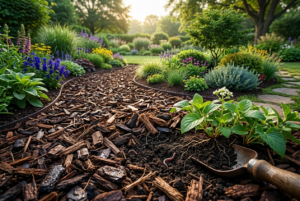
The signs that mulch needs replacing aren’t always dramatic, which is why they get missed. If the mulch has faded and turned gray, it means that it has mostly broken down and lost its protective density. If weeds are pushing through freely, your barrier is gone. Grab a handful: if it crumbles like dry soil, it’s past functional use. If you see mold or smell something sour, it means anaerobic decomposition is happening, which can hurt roots. These aren’t just cosmetic problems; they mean that your soil is now open and unprotected.
How Bark Mulch Improves Soil Health Over Time
This is something most guides skip over, but it’s genuinely worth understanding. When bark mulch breaks down, it doesn’t just go away; it adds organic matter directly to your soil. That organic matter feeds microbial life, which in turn improves soil aeration, nutrient cycling, and water-holding capacity.
Over multiple mulch cycles, beds that are consistently maintained with quality bark mulch build noticeably richer, more fertile soil than unmulched beds. The breakdown is a feature, not a flaw, which is why it’s so important to choose good materials from the start.
Seasonal Maintenance Tips to Keep Mulch Looking Fresh
There isn’t just one “mulch day.” To keep beds healthy all year long, you need to pay attention to them every season.
- Spring is the most important time to act. Inspect depth, top up where needed, and rake out any compacted sections before the growing season begins.
- In summer, check for crusting on the surface. When mulch gets a hard top layer, water runs off instead of soaking in. You can fix this right away by lightly raking it open.
- Fall is when most people make the mistake of skipping maintenance. Before the heavy rains arrive, turn your mulch and confirm it isn’t compacted. Compacted mulch in a wet Pacific Northwest winter becomes a waterlogged barrier rather than a protective one.
- In winter, the main job is keeping mulch away from plant stems and tree trunks. Moisture trapped against bark is one of the leading causes of crown rot and fungal disease.
The Role of Bark Mulch in Temperature Regulation
One of the most important things that bark mulch does is keep things warm. Studies have shown that a well-mulched bed can keep soil temperatures up to 10°F lower on hot days than bare ground. This is because the mulch layer keeps the soil cooler in the summer. In winter, that same layer acts as a thermal buffer, protecting roots from hard freezes. In a climate that moves between wet, cold winters and dry, warm summers, this insulation effect directly influences plant survival and performance. Thin or degraded mulch loses this benefit almost entirely.
The difference between mulched and unmulched soil in a dry summer isn’t just moisture; it’s the margin between a plant thriving and a plant dying.
When to Top Up vs. Fully Replace
This decision comes down to one honest assessment: what’s actually underneath?
Top up when depth has dropped below 2 inches, but the existing mulch still has structure, no odor, and no visible mold.
Fully replace when the material has decomposed to a soil-like consistency, there’s fungal growth, or the bed hasn’t been touched in more than 3 years.
The best depth for bark mulch is 2 to 4 inches, no more, no less. Below 2 inches, the soil is under-protected. Above 4 inches, rainfall can’t penetrate properly, and you end up with a layer that repels the very moisture it’s supposed to retain.
Avoiding Common Bark Mulch Mistakes
One of the worst things you can do to a tree that has been around for a while is to pile mulch right up against its trunk, which landscapers call “volcano mulching.” It traps moisture against the bark and creates ideal conditions for rot and disease. Always leave a 2 to 3 inch gap. Another common mistake is putting fresh mulch on top of old mulch without checking what’s underneath. If the material at the base is compacted and broken down, it can form a hydrophobic layer that keeps water from reaching the roots. Putting more mulch on top doesn’t fix what’s wrong underneath.
Choosing Quality Bark Mulch for Longer Life
Organic mulch care tips start before mulch even touches your soil; they start with what you buy. Low-quality material breaks down faster, can add weed seeds, and can take nitrogen out of the soil as it breaks down. High-quality bark mulch, when sourced correctly, provides all of the benefits: it keeps moisture in, keeps weeds down, controls temperature, and slowly adds nutrients to the soil.
As a trusted Tacoma bark mulch supplier serving Gig Harbor, Lakewood, Graham, Port Orchard, Steilacoom, and Bonney Lake, WA, Randles Sand and Gravel supplies landscape bark built to perform in Pacific Northwest conditions. You can easily get the right materials for your project in the South Puget Sound area because they can be picked up or delivered.
Your Mulch, Your Garden: Make It Count
Bark mulch works quietly, so when it fails, it does so quietly until it doesn’t. Understanding how long bark mulch lasts, catching the signs that mulch needs replacing early, and following consistent bark mulch maintenance tips are what separates a garden that stays healthy from one that slowly declines. Keep beds at 2 to 4 inches, refresh on a 1 to 2 year cycle, and choose quality material from the start. That’s the full picture.
At Randles Sand and Gravel, we’ve been supplying homeowners and contractors with quality landscape bark, topsoil, compost, and more since 1987. With three locations spanning the Puget Sound to Mt. Rainier, and a fleet ready to deliver to Tacoma, Gig Harbor, Lakewood, Graham, Port Orchard, Steilacoom, and Bonney Lake, WA, we make it easy to get what you need, where you need it.
Ready to refresh your beds with bark that actually lasts? Call us at (253) 531-6800 or stop by one of our three locations; our team is ready to help you choose the right product and get it delivered on your schedule.